Introduction
Varicose veins and spider veins are both common conditions that affect many people, but they are not the same thing. Though they're often lumped together in casual conversation—and both can appear on the legs—they differ significantly in size, cause, symptoms, and the treatments used to address them.
In this article, we explore the difference between Varicose Veins and spider veins, as explained by Dr. Shoaib Padaria, one of India's leading Vein Specialists and Past President of the Venous Association of India. Understanding this distinction can help you recognize which condition you may be dealing with and what treatment path makes the most sense.
Varicose Veins
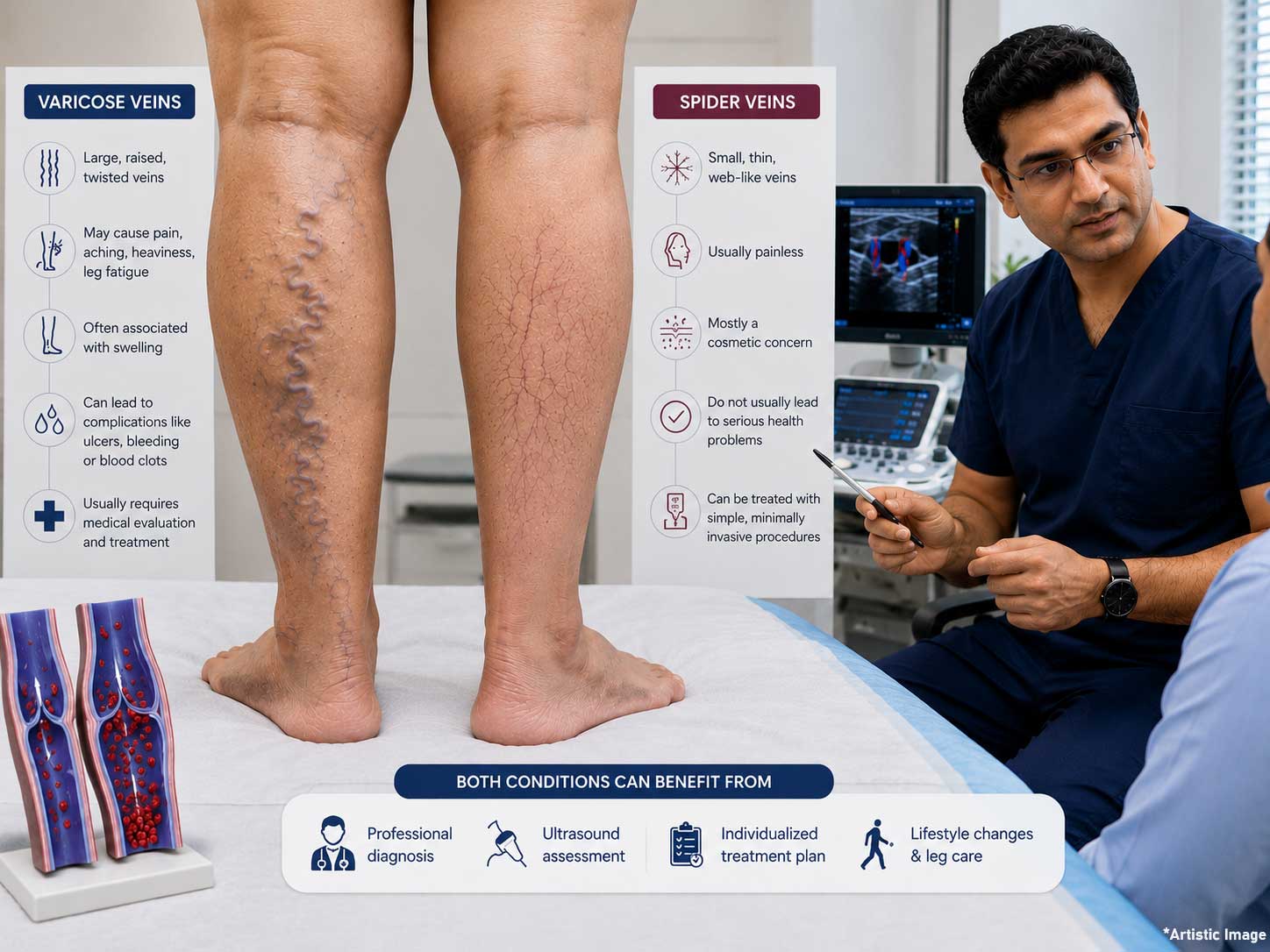
Varicose veins are enlarged, twisted veins that are often blue or purple in colour. They can occur anywhere in the body, but they are most commonly found in the legs, where veins must work hardest against gravity to return blood to the heart.
Varicose veins are caused by damaged vein valves, which allow blood to flow backward and pool in the veins. This backward flow, known as venous reflux, causes increased pressure within the vein, leading it to stretch, bulge, and twist over time, resulting in the enlarged, rope-like appearance associated with Varicose Veins.
Symptoms of Varicose Veins can include pain, swelling, and aching in the legs, along with heaviness, cramping, and itching around the affected area. In more advanced cases, they can also lead to skin discoloration or ulcers if left untreated.
Spider Veins
Spider veins are smaller, thinner veins that are often red or blue in colour, forming fine, web-like or branching patterns just beneath the surface of the skin. They are usually found on the legs or face and are often caused by genetics or hormonal changes, such as those occurring during pregnancy or menopause.
Unlike Varicose Veins, spider veins are not usually painful or harmful, but they can be unsightly and may cause some discomfort, particularly for those who are self-conscious about their appearance. Sun exposure, prolonged standing, and hormonal fluctuations are also commonly linked to their development, especially on the face.
Difference Between Varicose Veins and Spider Veins
The main difference between Varicose Veins and spider veins is their size and appearance. Varicose veins are larger (more than 3 mm) and more twisted than spider veins, and they often cause more symptoms, including pain and swelling that can interfere with daily activities.
Spider veins are smaller (less than 3 mm) and thinner than Varicose Veins, and they are usually not painful or harmful. However, occasionally spider veins may be responsible for pain or a burning sensation, especially in the thigh region, so their symptoms shouldn't be entirely dismissed either.
Another key difference lies in depth: Varicose Veins typically involve larger veins located deeper beneath the skin, while spider veins are confined to tiny superficial vessels near the skin's surface. This structural difference is a major reason why the two conditions are treated differently.
Treatment Options
Treatment options for Varicose Veins and spider veins vary depending on the severity of the condition. Compression stockings may be recommended for both conditions to improve circulation in the legs and reduce symptoms like heaviness and swelling, regardless of which type of vein is involved.
Sclerotherapy is a minimally invasive procedure that involves injecting a solution directly into the affected veins to collapse them. This treatment is often used for spider veins, as it's particularly effective for smaller, superficial vessels and typically requires little to no downtime.
For Varicose Veins, endovenous laser treatment (EVLT) and radiofrequency ablation (RFA) are minimally invasive procedures that use laser energy or radiofrequency energy to close off the affected veins from within, redirecting blood flow to healthy nearby veins.
Additional options such as glue therapy, MOCA, microwave laser therapy, HIFU, and steam ablation further expand the range of treatments available for Varicose Veins, allowing your specialist to choose the approach best suited to the size, depth, and location of your affected veins.
Which Condition Do You Have?
If you're unsure whether you're dealing with Varicose Veins or spider veins, a simple visual assessment is often the first clue—larger, raised, twisted, and darker veins point toward Varicose Veins, while fine, flat, web-like red or blue patterns suggest spider veins. That said, a professional evaluation is the only reliable way to confirm the diagnosis and rule out any underlying venous insufficiency.
A vein specialist can perform a clinical examination, often supported by a Doppler ultrasound, to accurately identify which condition you have and whether deeper venous issues are contributing to the visible veins on the surface.
Conclusion
In conclusion, Varicose Veins and spider veins are two different conditions that require different treatment options. While both conditions can be unsightly, Varicose Veins often cause more symptoms than spider veins, and typically require a different set of minimally invasive procedures to treat effectively.
If you're experiencing symptoms of Varicose Veins or spider veins, it's important to talk to a Vein Specialist like Dr. Shoaib Padaria to determine the best treatment plan for you.