
↗
Virtually Painless
Patients typically feel only a mild vibrating sensation during the procedure.
A next-generation, non-thermal treatment for Varicose Veins designed for faster recovery, minimal discomfort, and maximum precision.
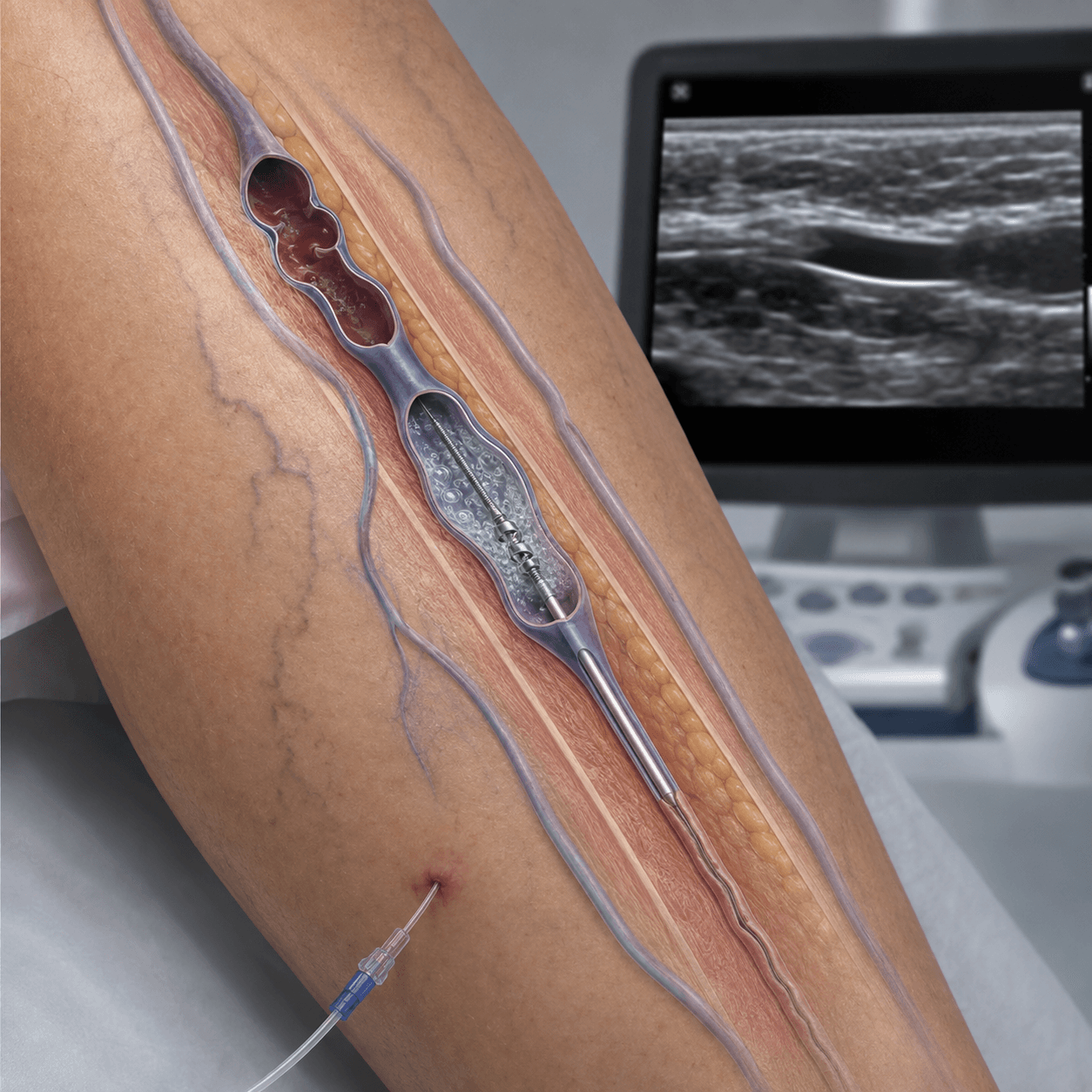
Mechanical action and chemical Closure — without relying on heat.
MOCA combines mechanical Vein wall disruption with a chemical sclerosant to permanently close diseased veins with minimal discomfort — and without using heat.
Instead of using thermal energy, MOCA uses a rotating wire to disrupt the Vein wall while a sclerosant is released at the same time.
The technique minimizes anesthesia, needle access and recovery demands while treating the diseased Vein.
Unlike laser or RFA, MOCA doesn't require tumescent anesthesia injected along the entire Vein.
Only one small local anesthetic injection is needed to numb the treatment area.
Most patients return to normal daily activities within a day.
MOCA brings together mechanical disruption and chemical sclerosis to close the treated Vein without thermal energy.
A rotating wire tip causes the Vein wall to spasm and contract.
A chemical sclerosant is released to seal the Vein shut.
Blood naturally redirects through healthier veins after treatment.
The entire MOCA procedure typically takes about 20 minutes and is performed on an outpatient basis under local anesthesia.
The affected Vein is precisely mapped using duplex Ultrasound.
MOCA differs from heat-based methods such as laser and radiofrequency ablation.
From comfort during treatment to getting back to everyday activities, MOCA is designed around a minimally invasive patient experience.
Patients typically feel only a mild vibrating sensation during the procedure.
Eliminates risk of nerve or skin injury since no thermal energy is used.
Only one tiny local anesthetic injection is required for the whole procedure.
Walk in, treat the Vein, and return home the same day.
Clinically proven Closure rates comparable to laser and radiofrequency ablation.
Performed through a single puncture point, leaving virtually no mark.
Most patients can return home on the same day and resume normal daily activities, including walking, shortly after treatment.
Understanding the procedure can make your treatment decision easier.
It is essential that MOCA is performed by an expert who has thoroughly evaluated the patient and is highly experienced in the technique.
Every varicose Vein case is unique, and the treating doctor determines the most suitable procedure — sometimes combining techniques for optimal results.
Active faculty in national and international workshops.
A detailed evaluation and duplex Ultrasound can help determine the most suitable treatment for your veins.